Wingfoil: transiciones, giros y cambios de dirección
Por el equipo de Escuela de Wingfoil · Octubre 2026
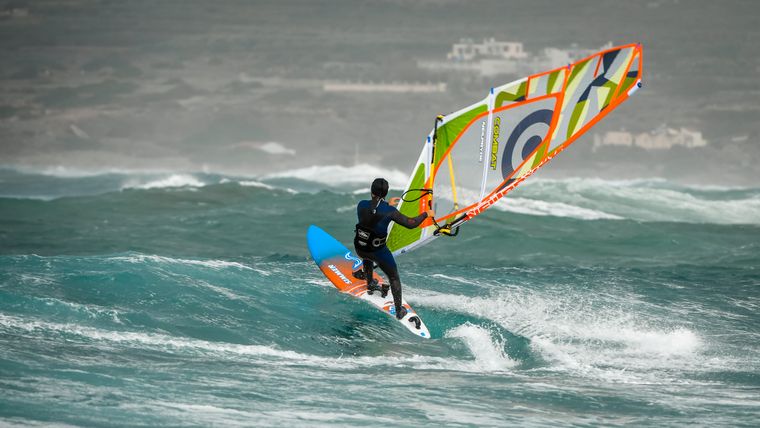
Ir derecho es la mitad del wingfoil; la otra mitad es dar la vuelta sin perder lo que ganaste. Hay tres formas de cambiar de dirección, de la más simple a la más avanzada: el giro parado, la trasluchada y la virada. Acá van las tres, paso a paso.
Dos palabras para entenderse
- Trasluchada (gybe): girás pasando la cola de la tabla por el viento, es decir, hacia abajo del viento. Es la más fácil de las dos.
- Virada (tack): girás pasando la nariz de la tabla por el viento, es decir, contra el viento. Es más difícil, pero no perdés barlovento.
1. El giro parado (para principiantes)
Es lo primero que se aprende, con la tabla apoyada:
- Llevá el ala a neutro y frená.
- Arrodillate o quedate parado con las piernas flexionadas en el centro de la tabla.
- Girá la tabla con los pies (o empujándola con la mano) hacia la nueva dirección.
- Cambiá las manos en el ala y volvé a cargarla del otro lado.
Es lento, pero seguro. Hasta que no te salga sin caerte, no pases al siguiente.
2. La trasluchada
Primero con la tabla apoyada (touch and go)
- Abrí el rumbo: empezá a girar hacia abajo del viento cargando suave los talones o las puntas, según el lado.
- Aliviá el ala: mientras girás, el viento queda atrás tuyo y el ala tira menos. Sostenela alta y liviana.
- Pasá el ala: cuando el viento te queda de espaldas, soltá la mano de atrás, pasá el ala por encima de tu cabeza y tomá la manija de adelante del otro lado.
- Cambiá los pies o seguí en switch (con los pies al revés) si todavía no te sale el cambio.
- Cargá el ala del nuevo lado y seguí navegando.
Después, volando
La secuencia es la misma, pero sobre el foil. La clave es mantener la velocidad: entrá al giro rápido, hacé un arco amplio inclinando la tabla y no frenes con el ala. Si la tabla baja en el medio, ayudate con un par de bombeos del ala del lado nuevo. Muchos riders primero aprenden a salir de la trasluchada en switch y recién después a cambiar los pies.
3. La virada
Es la maniobra más difícil del wingfoil básico, porque pasás por un momento en que el ala no tira nada:
- Ceñí: navegá en un rumbo cerrado al viento, con buena velocidad.
- Orzá: girá hacia el viento hasta que la nariz lo cruce.
- Pasá por delante del ala: el ala queda sobre tu cabeza; cambiá de lado rápido y cambiá los pies.
- Cargá el ala del nuevo lado antes de que la tabla se frene del todo.
Practicala primero con la tabla apoyada y con viento parejo. Volando, llega más adelante (lo ubicamos en el mes 6 de la progresión en 6 meses).
Los errores más comunes en los giros
| Lo que pasa | Por qué | Qué hacer |
|---|---|---|
| La tabla se frena y caés en el medio del giro | Poca velocidad de entrada o frenaste con el ala | Entrar más rápido y con el ala liviana. Pumping al salir. |
| Caés justo al cambiar el ala | Bajaste la mirada o soltaste las dos manos a la vez | Mirada a la salida del giro; soltá una mano por vez. |
| Terminás muy a favor del viento | Arco demasiado amplio o salida muy abierta | Salir con el ala cargada y ceñir apenas terminás. |
| El foil sale del agua en la curva | Mucho peso atrás al inclinar | Peso al pie de adelante, tabla nivelada. |
Drills que preparan los giros
- Cambio de mano del ala caminando en la playa.
- Carving en S y una mano en el ala mientras volás.
- Todos explicados en drills de equilibrio y control.
Los giros son la etapa donde un instructor más tiempo te ahorra: una corrección a tiempo vale semanas de prueba y error.
Riding straight is half of wingfoil; the other half is turning around without losing the ground you've gained. There are three ways to change direction, from simplest to most advanced: the stopped turn, the gybe and the tack. Here are all three, step by step.
Two words to get straight
- Gybe: you turn by passing the tail of the board through the wind, that is, downwind. It's the easier of the two.
- Tack: you turn by passing the nose of the board through the wind, that is, upwind. It's harder, but you don't lose ground.
1. The stopped turn (for beginners)
It's the first thing you learn, with the board on the water:
- Take the wing to neutral and stop.
- Kneel, or stay standing with bent legs in the middle of the board.
- Turn the board with your feet (or push it with your hand) towards the new direction.
- Switch hands on the wing and power it up on the other side.
It's slow, but safe. Don't move on until you can do it without falling.
2. The gybe
First with the board on the water (touch and go)
- Bear away: start turning downwind by gently weighting your heels or toes, depending on the side.
- Depower the wing: as you turn, the wind ends up behind you and the wing pulls less. Hold it high and light.
- Pass the wing: when the wind is at your back, let go with your back hand, pass the wing over your head and grab the front handle on the other side.
- Switch your feet, or keep riding switch (feet reversed) if you can't do the switch yet.
- Power the wing on the new side and keep riding.
Then, on foil
Same sequence, but on the foil. The key is keeping your speed: go into the turn fast, carve a wide arc by tilting the board and don't brake with the wing. If the board drops mid-turn, help yourself with a couple of pumps of the wing on the new side. Many riders first learn to exit the gybe riding switch and only later switch their feet.
3. The tack
It's the hardest manoeuvre of basic wingfoil, because there's a moment when the wing isn't pulling at all:
- Point upwind: ride close to the wind with good speed.
- Head up: turn into the wind until the nose crosses it.
- Move in front of the wing: the wing goes over your head; switch sides quickly and switch your feet.
- Power the wing on the new side before the board stops completely.
Practise it first with the board on the water and in steady wind. On foil, it comes later (month 6 of the 6-month progression).
The most common turning mistakes
| What happens | Why | What to do |
|---|---|---|
| The board stalls and you fall mid-turn | Not enough entry speed or you braked with the wing | Enter faster with a light wing. Pump on the way out. |
| You fall right as you switch the wing | You looked down or let go with both hands at once | Eyes on the turn exit; release one hand at a time. |
| You end up far downwind | Arc too wide or exit too far off the wind | Exit with the wing powered and point upwind as soon as you finish. |
| The foil breaches in the curve | Too much weight back as you lean | Weight on the front foot, board level. |
Drills that prepare your turns
- Switching wing hands while walking on the beach.
- S-carving and one hand on the wing while flying.
- All explained in balance and control drills.
Turning is the stage where an instructor saves you the most time: one correction at the right moment is worth weeks of trial and error.